


Blueprint · Working through a topic
The cow model: breadth, depth and habit in working through a topic
Five thinking operations behind four images: the fenced pasture, rumination, milk and dung, and cattle trails on the slope
Breadth inside the frame, depth through return, habit through the path.
- By
- By Saina Veigel · Communications Specialist · Senior Technical Writer
- Edition
- 1
- First published
- Reviewed
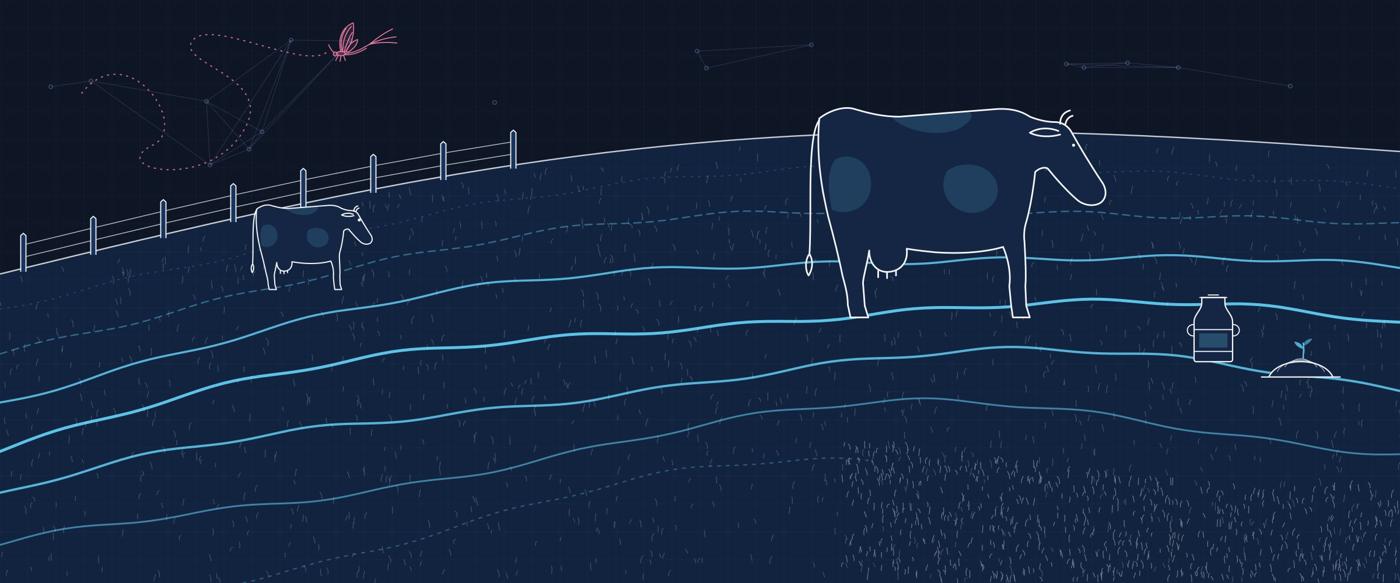
The cow model describes how an author works through a topic before publishing on it. It combines four images: the fenced pasture, digestion, milk and dung, and cattle trails on the slope.
Behind each image stands a thinking operation that can be carried out and checked. The fence sets the frame. Rumination returns to the material in several passes. Milk is the result that serves the reader. Dung is the remainder that fertilizes the next topic. The trail is the habit that grows from repeated walks.
The images are memorable on purpose. They are not the model’s argument. The argument lies in the operations and in what is known about them from analysis and from brain research. This blueprint names both and keeps them apart from the author’s own combination.
What the model needs
The model has two ingredients: the human brain, which every person has, and the will to make the cow model part of one’s habits and stance, so that complex thinking becomes habitual.
The first ingredient needs no qualification. Comparisons of brain size are made between species, not between people; the model makes no claim that a larger brain thinks faster or better. It only says that the tool is there.
The second ingredient needs a closer look. The will sets the start. It does not carry the path on its own. Research on habits describes how actions that are repeated in a stable context come to need less deliberate effort. For the model this means: the context keeps the path open once the will has opened it.
What carries the path once the will has set it:
- a fixed time for working through a topic
- a fixed place
- the same first step every time
- a frame written down before reading
- a pause between passes
- notes that are always at hand
- one question carried from topic to topic
The will sets the start; the context carries the path.
Cows walk the same routes every day. The path is kept open by the walking, not by the resolve to walk.
Counterimage: the mayfly
The counterimage of the cow is the mayfly: thinking that follows triggers and emotions and produces pleasure that does not outlast the day. It describes what happens when the five operations are left out.
- Without the fence, grazing turns into drifting from one trigger to the next.
- Without rumination, the first impression becomes the text.
- Without the reader’s test, the text serves the author’s mood of the moment.
- Without the dung, every topic starts from nothing.
- Without the trail, every thorough analysis remains an exception.
The mayfly’s question is “What gets the click?” The cow model asks: “What remains after the click?” The pleasure of the mayfly is an image, not a finding about the brain. In the author’s view, news and social media live on the mayfly.
Blueprints
The cow model stack
Five thinking operations behind four images
The stack is the practical structure behind the images. Each image stands for a thinking operation with its core question and the decisions it shapes. Pasture and rumination work in sequence; milk and dung are the two results; the trail grows from all of them over time.
Scroll sideways to see every column.
| Operation | Core question | Decisions |
|---|---|---|
| The fenced pasture | What is the frame of the topic, and what lies inside it? | Guiding question · in and out of scope · range of sources · positions and counterpositions |
| Rumination in four passes | How often has the material been brought back and worked through? | Number of passes · distance between passes · what is sorted out · what is condensed · the decision |
| Milk | What would make the text useless to the reader? | What the reader needs · what the reader already knows · what is left out · form and order |
| Dung | What remains, and where will it fertilize the next topic? | What is kept · how it is labeled · where it is filed · which open question it carries |
| Cattle trails on the slope | Is thorough analysis becoming a path, or does it remain an exception? | Regularity · the fixed context · the first step · what is practiced deliberately |
The stack is not a theory of thinking. It is a sequence of operations that an author can carry out and check.
Breadth inside the frame, depth through return, habit through the path.
The situation lens · Reference
The cow model in typical situations
The five operations applied to the topics an author typically works through
The grid shows how the operations change with the occasion. A new regulation needs a different fence than a reply to an expert position, and the sign of the mayfly looks different in each case.
Scroll sideways to see every column.
| Situation | The fence | The passes | The milk test | The dung | Sign of the mayfly |
|---|---|---|---|---|---|
| A new regulation or standard | Which provisions, which products, which date of application | Text of the act · official guidance · positions of practitioners · own reading again | Can the reader tell what changes for their documentation and from when? | Open interpretation questions · provisions left for later | Summarizing the press release on the day it appears |
| A professional article or post | One question the article answers · what it leaves to others | Sources and counterpositions · the draft read with distance · cut to the core | Does the reader take away something they can use? | Side arguments · material for the next part | Writing to the trend of the week |
| Reworking existing documentation | Which product, which audience, which documents | Reading the current text · comparing it with the product · sorting what stays · deciding | Can the reader do the task with the reworked text? | Findings about other documents · questions for development | Changing wording without checking the product |
| A reply to an expert position | The claim being answered · the ground the reply covers | The original position in full · its sources · own counterposition · the reply read again | Does the reader understand both positions before the reply? | Points of agreement · questions for a later reply | Answering the headline, not the argument |
The rows are examples. The columns stay the same for every topic.
The same five operations, a different fence each time.
Crosswalk · Thinking models for technical writers
The cow model and the writer’s stack
Which thinking layers of the writer each operation prepares
The blueprint “Thinking models for technical writers” describes ten thinking layers that structure complexity before writing begins. The cow model works one step earlier: it describes how the author works through the topic itself. The crosswalk shows which writer’s layers each operation prepares.
Scroll sideways to see every column.
| Operation | Writer’s layers it prepares | What it adds |
|---|---|---|
| The fenced pasture | System thinking · First principles thinking | A frame and its boundaries before the structure is built |
| Rumination in four passes | First principles thinking · Clarity thinking | Material that has been sorted, condensed and decided |
| Milk | Task thinking · Clarity thinking · Publication logic thinking | The reader’s test before the text is published |
| Dung | Component thinking · Metadata thinking | A remainder filed so that it can be found and reused |
| Cattle trails on the slope | All ten layers | The habit that makes the layers available without effort |
The crosswalk is not a one-to-one mapping. Each operation touches several layers; the table names the ones it prepares most directly.
The cow model works through the topic. The writer’s stack structures what comes out of it.
The five thinking operations
Each operation stands behind one image. Each has its core question, its decisions and its limits.
1. The fenced pasture
Core question: What is the frame of the topic, and what lies inside it?
The fence is the frame of the topic. Within it, the author grazes widely and takes in sources, positions and counterpositions. The breadth stays inside the frame.
The author asks:
- Which question does the topic answer?
- What belongs inside the fence, and what stays outside?
- Which sources, positions and counterpositions are on this pasture?
- Whose position have I not read yet?
- Where does the breadth start to leave the frame?
Grazing widely and setting a frame are two different movements. Grazing opens: it collects material, including material that contradicts the author’s first view. The fence closes: it decides what the topic is about and what it is not about.
The fence comes first. Without it, breadth has no direction, and every new source moves the topic. With it, breadth becomes useful: the author can take in a great deal because it is clear where it belongs.
The fence can be moved. When the material shows that the frame was wrong, the author sets it again — openly, not by drifting.
- Breadth is not the same as drifting.
- A fence is a decision, not a limitation.
- Counterpositions belong inside the fence.
The breadth stays inside the frame.
Decisions
- Guiding question
- in and out of scope
- range of sources
- positions and counterpositions
2. Rumination in four passes
Core question: How often has the material been brought back and worked through?
A cow’s stomach has four compartments, and the cow ruminates: it brings food back up and chews it again. The author goes into depth in the same way, returns to the material several times and works it through until it can be absorbed.
The author asks:
- Have I only taken the material in, or have I already brought it back?
- What have I sorted out, and why?
- What is left once the repetitions and the noise are gone?
- What do I actually think after the last pass?
- Could I explain the topic without my notes?
The model turns the four compartments into four passes. Rumen: take in — the material is collected and stored, still unsorted. Reticulum: sort and bring back — the material is sorted, and what needs more work comes back up to be chewed again. Omasum: condense — what is redundant is drawn off, as the omasum draws off water. Abomasum: decide — only here does the actual digestion take place, and the author decides what the text will say.
The order follows the biology fairly closely: feed passes from the rumen and reticulum, where the cud is brought back up, through the omasum to the abomasum, the true stomach. The parallel is still a sharpening, not a description of how thinking works. It gives the passes a sequence that can be checked.
The passes need distance. Returning to the material after a pause shows what was understood and what only felt familiar. One long pass does not replace four short ones.
- Taken in is not digested.
- Shorter is not the same as condensed.
- The decision comes last, not first.
Depth comes from return, not from duration.
Decisions
- Number of passes
- distance between passes
- what is sorted out
- what is condensed
- the decision
3. Milk
Core question: What would make the text useless to the reader?
The output is milk: a text that nourishes its readers. The test for milk is not whether the author is satisfied, but whether the reader can use it.
The author asks:
- What would make the text useless to the reader?
- Which knowledge do I take for granted that the reader does not have?
- What does the reader do with the text once they have read it?
- Which part of my material belongs in the text, and which in the dung?
The milk test turns the question around. Instead of asking what makes the text good, the author asks what would make it useless: a missing step, an unexplained term, a conclusion without its reason, a wall of material without an answer.
The author knows the topic after four passes. The reader does not. What the author no longer notices — the background, the abbreviation, the obvious next step — is often exactly what the reader lacks.
- Milk is for the reader, not for the author.
- Everything that was digested does not have to become milk.
A text is milk when it nourishes someone else.
Decisions
- What the reader needs
- what the reader already knows
- what is left out
- form and order
4. Dung
Core question: What remains, and where will it fertilize the next topic?
The dung has value as well: notes, discarded material and open questions fertilize the next topic.
The author asks:
- Which material did not go into the text, and why?
- Which open question did the topic leave?
- How will I find this material again?
- To which next topic does it lead?
Not everything that is digested becomes milk. The remainder is not waste. A side argument, a source that did not fit the frame, a question that the text could not answer — each can become the start of the next topic.
Dung only fertilizes when it is spread. Notes that cannot be found again are lost. The author files the remainder so that it can be found and connected: with a short label, the question it carries and the topic it came from.
- Discarded is not worthless.
- An open question is a result, too.
Every topic leaves the ground richer for the next one.
Decisions
- What is kept
- how it is labeled
- where it is filed
- which open question it carries
5. Cattle trails on the slope
Core question: Is thorough analysis becoming a path, or does it remain an exception?
On steep pastures, cattle tread horizontal paths into the hillside by walking the same routes year after year. Every thorough analysis is a walk across the slope, and repeated walks become a path that can be walked with ease and pleasure. Slopes that nobody walks become overgrown.
The author asks:
- How often do I walk the whole path — fence, passes, milk and dung?
- In which fixed context do I work through a topic?
- Which operation do I still skip when time is short?
- Which operation do I practice deliberately?
The brain responds to habitual practice in a comparable way. Brain research describes how connections that are used together are strengthened (Donald O. Hebb, 1949) and how actions repeated in a stable context become habits that need less deliberate control (Wendy Wood and David T. Neal, 2007). The cow model uses this as an image. It does not claim a finding of its own.
The path grows from walking, not from intending to walk. The cows walk the same routes every day; the route stays the same, and so the path forms. For the author this means a fixed context: the same time, the same place, the same first step.
An overgrown slope can be walked again. It takes more effort at first, and less with every walk.
- One thorough analysis is a walk, not a path.
- The path is kept open by walking.
Complex thinking becomes habitual when it is walked often enough.
Decisions
- Regularity
- the fixed context
- the first step
- what is practiced deliberately
Why the cow model matters
The cow model matters because publishing has become fast and thinking has not.
- If the frame is missing, the topic follows the latest source.
- If the material is never brought back, the text repeats the first impression.
- If nothing is condensed, the reader gets the author’s notes instead of an answer.
- If the decision is postponed, the text describes positions without taking one.
- If the reader’s test is missing, the text serves the author.
- If the remainder is lost, every topic starts from nothing.
- If the path is never walked, every thorough analysis takes as much effort as the first.
Working through a topic is not finished when the author has read enough. It is finished when the result nourishes the reader and the remainder fertilizes the next topic.
From the images to the decisions
The images become useful when they turn into distinctions the author can make about their own work.
Before publishing, the author asks:
- Grazed inside a frame or drifted?
- Positions only, or counterpositions too?
- Taken in or brought back?
- Condensed or only shortened?
- Decided or postponed?
- Milk or dung?
- Filed or lost?
- A path or an exception?
- A question or a trigger?
These distinctions do not judge the author. They show which operation is still missing.
What tools can and cannot do
Search engines, note apps and AI assistants can make the pasture larger and keep the dung retrievable. They can collect sources, summarize positions and file notes.
They cannot ruminate for the author. The passes, the condensing and the decision are the author’s work. A summary that a tool produces is material for the first pass, not the result of the fourth.
A tool can:
- widen the range of sources inside the fence
- find counterpositions the author has not read
- keep notes and open questions retrievable
- remind the author of the fixed time and place
A tool can carry the dung. It cannot chew the cud.
The core principle
The core principle is simple: breadth inside the frame, depth through return, habit through the path.
The four images make the operations memorable. The operations make the images useful. The established methods and the brain research named below show that the operations are not new on their own; what is the author’s own is their combination and its application to authorship on professional networks.
The cow model is a thinking model. It supports decisions about working through a topic; it is not a scientific theory, and it makes no claim about how an individual brain works.
Cut complexity — create clarity
Explained in context
Context cards explain the general, checkable background of some of the questions this blueprint raises. They are written by knowledge.aitechdoc.world and are not part of the blueprint.
Reference updates
The glossary references, the terms under “Related established methods” and the context cards are attached to this blueprint, not part of it. They are checked and updated on their own, without a new edition.
The references haven’t been updated since the first edition.
How to cite
Saina Veigel (2026). The cow model: breadth, depth and habit in working through a topic. Blueprint, edition 1. knowledge.aitechdoc.world. https://knowledge.aitechdoc.world/blueprints/cow-model
Edition and changes
Edition 1 · Reviewed
Corrections (something was wrong) and additions (something was missing) since the first edition.
No corrections or additions since the first edition.
About this blueprint
This blueprint is a thinking model, not a standard or a method certified by anyone. Naming a standard, a law or an established method does not mean that documentation conforms to it.
It does not replace the manufacturer’s risk assessment, the instructions for use of a product or the review of documentation by the people responsible for it.
Copyright © 2026 Saina Veigel. All rights reserved. Copyright notice