


A multi‑domain reference space for terminology, regulatory frameworks and information‑architecture structures used in technical documentation. Glossaries are cross‑linked through SKOS relations; context cards provide concise, self‑contained explanations of the technical background behind AI‑related documentation tasks, regulatory changes and industry news.

AI TechDoc Knowledge | Glossaries and Frameworks
A reference space for the terms, norms and frameworks behind technical documentation in the age of AI.
A standalone architecture model for system coordination. Its eight elements, SC1 to SC8, describe how software, control, communication, motion, safety, diagnostics, people and models work together across defined layers and interfaces. The framework is a conceptual model in its own right, separate from the glossaries, and serves as a reference for analysing, designing and discussing coordinated systems.
Saina Veigel's personal space for notes and reflections on clarity, safety and semantics, and on technology that empowers the people who use it. The notes follow the intersection of regulation, technical documentation and product communication, where a precise sentence decides whether a system is understood, trusted and used safely.
The glossaries
- AI glossary & learning path92 termsOpen glossary

- Information architecture & ontology52 termsOpen glossary

- DITA 1.325 termsOpen glossary

- AI Act vs. USA, Canada & China55 termsOpen glossary

- Machine safety & safeguarding166 termsOpen glossary

- Functional safety & systems engineering219 termsOpen glossary
- Safety documentation, compliance & security117 termsOpen glossary

- DPP & EU omnibus vs. USA, Canada & China25 termsOpen glossary

- MedTech & pharma: MDR, IVDR, GxP & ICH102 termsOpen glossary

- PLC, control engineering & SCADA265 termsOpen glossary
- Automation components, sensors & drives404 termsOpen glossary

- Robotics, vision & manufacturing operations277 termsOpen glossary

- Industrial communication, IIoT & OT security270 termsOpen glossary

- Automation software & system integration464 termsOpen glossary
- Software development kits (SDKs)56 termsOpen glossary

- Technical documentation & information design61 termsOpen glossary

- Philosophy, reasoning & mental models60 termsOpen glossary

- Cognitive psychology57 termsOpen glossary

- Applied cognitive psychology27 termsOpen glossary

New white paper · free download
From knowledge graphs to adaptive semantics
Evolving DITA and iiRDS digital twins for AI
By Michael Iantosca, Senior Director of Content Platforms and Knowledge Engineering.
AI regulationTechnical documentationSemantic systemsKnowledge graphsMetadataEU AI ActSafety SystemsSecurity SystemsAI regulationTechnical documentationSemantic systemsKnowledge graphsMetadataEU AI ActSafety SystemsSecurity SystemsAI regulationTechnical documentationSemantic systemsKnowledge graphsMetadataEU AI ActSafety SystemsSecurity SystemsAI regulationTechnical documentationSemantic systemsKnowledge graphsMetadataEU AI ActSafety SystemsSecurity Systems
What I cover
Nine fields, three questions, one editorial standard.
Every field answers one of three questions a reader brings to technical knowledge — and serves one of its three readers. The three readers are lenses, not single people: behind each of them stand several roles, from the people who write and check the source to the systems that compile and answer from it. Read a row from left to right, or a column from top to bottom.
The person behind this publication works in four core areas. Each of the nine fields below carries a badge with the core area it belongs to.
The four core areas on sainaveigel.com- 01Information architecture and semantics
- 02Regulated documentation and safety communication
- 03AI-ready content and AI regulation
- 04Learning and communication
The source
Not a reader in itself: the decided content, checked by the people who write, supply, review and release it.
Is it decided, consistent and traceable?
The person
Everyone who reads and acts on it — each with a different qualification, authority and situation: the instructed operator, the trained operator, the skilled person, the auditor.
Can I understand it and act on it safely, here and now?
The third reader
Every system between the source and the person: integrations, content systems, translations, portals, answer functions and agents. Some read, many compile, a few write back.
Does the next system know which value counts?
How the three readers break down into roles — writing, deciding, compiling, using and writing back — is described in the blueprint on the role grammar of technical information. The role grammar: readers, writers and compilers
The sourcethe decided content and the people who write and check it
The personwho reads and acts on it — from the instructed operator to the skilled person
The third readersystems that pass it on, compile it or answer from it — AI is one of them
Meaning
What does it mean?
01Core area 01: Information architecture and semantics
The source · the decided content and the people who write and check it
Information architecture
How content is divided, named and related before a single sentence is written.
02Core area 01: Information architecture and semantics
The person · who reads and acts on it — from the instructed operator to the skilled person
Semantic systems
One term, one meaning — across documents, languages and teams.
03Core area 03: AI-ready content and AI regulation
The third reader · systems that pass it on, compile it or answer from it — AI is one of them
AI-ready content
Content that stays true when a model retrieves, summarises or paraphrases it.
Evidence
What must it prove?
04Core area 02: Regulated documentation and safety communication
The source · the decided content and the people who write and check it
Technical documentation
Instructions and technical files that remain accurate, auditable and genuinely useful.
05Core area 02: Regulated documentation and safety communication
The person · who reads and acts on it — from the instructed operator to the skilled person
Safety communication and evidence
From the hazard in the risk assessment to the warning in the manual — and the proof in between.
06Core area 03: AI-ready content and AI regulation
The third reader · systems that pass it on, compile it or answer from it — AI is one of them
AI regulation
What the AI Act, the CRA and related rules require — stated as of the date reviewed.
Communication
How does it reach people?
07Core area 04: Learning and communication
The source · the decided content and the people who write and check it
Learning design
How people build understanding step by step, and what cognitive research says about it.
08Core area 04: Learning and communication
The person · who reads and acts on it — from the instructed operator to the skilled person
Visual and multimedia communication
What a diagram, a map or a short film explains better than a paragraph.
09Core area 04: Learning and communication
The third reader · systems that pass it on, compile it or answer from it — AI is one of them
Technical and product marketing
Product knowledge turned into messages that match the documentation.
From thinking model to check method
Three readers find the questions. Check rules need roles.
The three readers above are a thinking model: enough to design a check method. To build your own check processes and check rules, each placeholder has to become a role — and each role a system, subsystem, function or subfunction a rule can name.
- 1
Thinking model
Three placeholders — the source, the person, the third reader — find the questions a check has to ask.
The nine fields - 2
Roles
Each placeholder opens into roles: who writes, decides, compiles, uses or writes back a value.
Who decides which value counts - 3
Check rule
Each role gets a unit, a value, a condition, evidence, an owner and a trigger.
The check rule grammar
CCMS › publishing subsystem › assembly function › revision lookup — the revision of every assembly in the order manual equals the revision released in PLM — evidence: the build record.
A placeholder finds the question. A role makes it checkable.
From the newsletter
Recent articles on AI TechDoc Press
11 November 2026
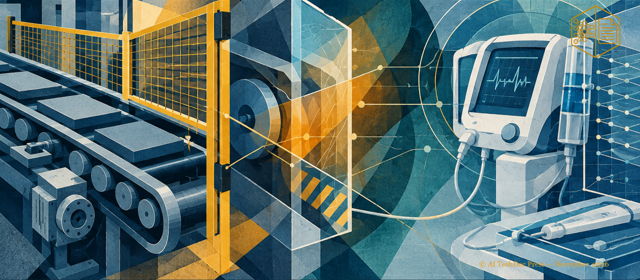
Was die Maschinen-Risikobeurteilung von der Medizintechnik lernen kann
Gefährdungsszenarien verbinden reale Handlungsabläufe mit Schutzmaßnahmen und Sicherheitsnachweisen
Read on Substack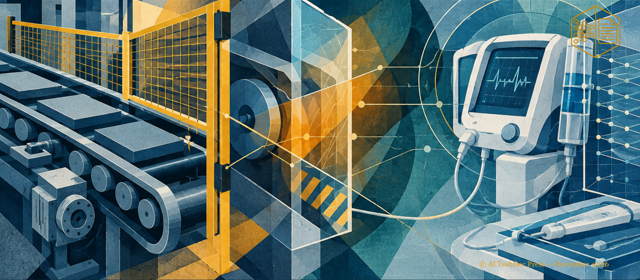
11 November 2026
What Machinery Risk Assessment can learn from MedTech
Hazard-related scenarios connect real-world activities with protective measures and safety evidence
Read on Substack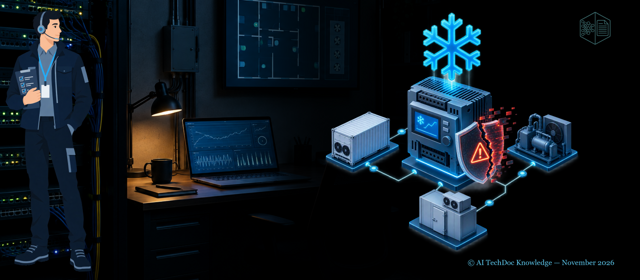
6 November 2026
AI TechDoc Friday: Cyberattacks on refrigeration systems in Europe
How manipulated controllers put cold chains at risk, and which safeguards help
Read on Substack6 November 2026
AI TechDoc Freitag: Cyberangriffe auf Kühlanlagen in Europa
Wie manipulierte Steuerungen Kühlketten gefährden und welche Schutzmaßnahmen helfen
Read on Substack
30 October 2026
Who can judge an AI model output? Competence as the weak point of an AI-enabled QMS
An AI tool in use is not a competence
Read on Substack
29 October 2026
KI im QMS: Der Prüfmaßstab verschiebt sich von der Wirkung auf die Beherrschung
Zwei Blickrichtungen auf denselben Gegenstand
Read on Substack
29 October 2026
EN 18286 certifies the system, not the company: An AI QMS that holds up in an audit
The first harmonized AI standard covers a very narrowly defined area
Read on Substack
28 October 2026
Die erste harmonisierte KI-Norm ist veröffentlicht – die Aufsicht fehlt noch in mehreren Ländern
KW43: Was ein KI-Qualitätsmanagementsystem nach Artikel 17 dokumentieren muss, damit es einer Prüfung standhält.
Read on Substack
28 October 2026
AI deployment is becoming an institutional design problem
AI adoption depends on the institutions around it — a global challenge
Read on Substack
28 October 2026
AI deals and deployments across Southeast Asia, Europe, and the US
A new AI lab and fresh deals mark the fortnight
Read on Substack
24 October 2026
Before an AI recommendation becomes a machine command
Industrial AI needs a documented handover from interpretation to action
Read on Substack
21 October 2026
Wenn KI-Agenten Grenzen überschreiten – 12. Oktober – 17. Oktober 2026
KW42: Agenten erreichen reale Systeme – entscheidend sind Zugriff, Eindämmung und Wiederanlauf.
Read on Substack
AI TechDoc Press on Substack
Stay ahead of what AI means for your documentation.
New articles land several times a week — analysis of regulation as it takes shape, practical guidance for documentation teams and a weekly look at international AI news. Free to read, straight to your inbox.
- Timely analysis of the EU AI Act and machinery regulation
- Practical guidance for documentation and product teams
- Weekly roundup of international AI news
- Premium deep dives for subscribers